
UPDATE 2/11/26: It has come to my attention that Enlightened Equipment’s sister company, Defense Mechanisms (same owner, same location), has intentionally or naïvely promoted far-right, fascist ideology. For this reason, I do not currently support EE/DM nor recommend their products. That being said, I urge those interested to read the accusations for themselves. Don’t let me or social media decide for you.
This review was originally published on TheTrek.co, and this quilt was donated for the purpose of review. If you have any quick questions about gear, please feel free to contact me. And if you want to dive deeper, or talk about other aspects of backpacking, I offer Thru-Hike Coaching. I’d love to contribute to your journey!
Over two decades of backpacking, I have always used a down sleeping bag or quilt. My old mummy bag got me through the Boy Scouts and my first thru-hike on the PCT in 2015. A 30°F down quilt took over the next year and was my go-to for many adventures, including the CDT in 2019. My down bags have always treated me well, even during a week of cold rain in Washington, and a -2°F cold-snap in New Mexico.
Shifting priorities, however, put me in the market for a new quilt made with synthetic insulation. Removing animal products from my diet and gear closet was my main motivation, but moving to synthetic makes sense for practical reasons as well, as I plan for a big hike in the humid and damp East.
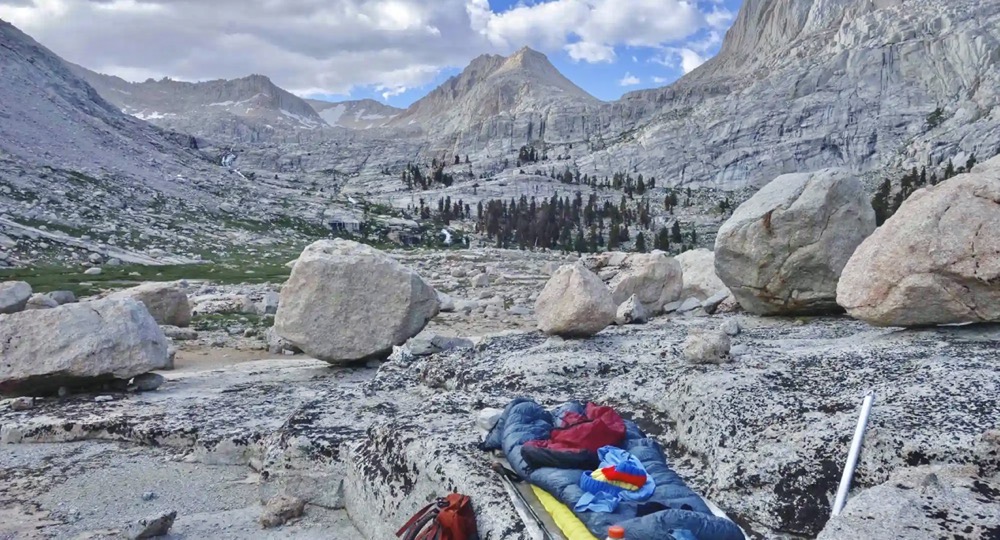
My search brought me to the Enlightened Equipment Enigma APEX quilt. EE is known for their minimalist, ultra-customizable backpacking gear, and after loving their Torrid APEX jacket on the CDT, I decided to give their quilts a shot too. This lightweight synthetic version checked all my boxes. Curious to see for myself how this synthetic insulation trades benefits and drawbacks with down, I headed for the hills, excited to finally experience the wilderness from a post-down perspective.
Enlightened Equipment Enigma APEX At-a-Glance
MSRP: $230 (As tested. Varies with chosen specs.)
Weight: 29.05 ounces (As tested. Varies with chosen specs.)
Temperature rating: 20°F (Also available: 30°, 40°, and 50°F)
Type: Quilt, closed footbox
Insulation: Synthetic Climashield APEX
Fabric: 10D nylon (7D, and 20D also available)
Country of Origin: Minnesota, U.S.A.
Intended Use
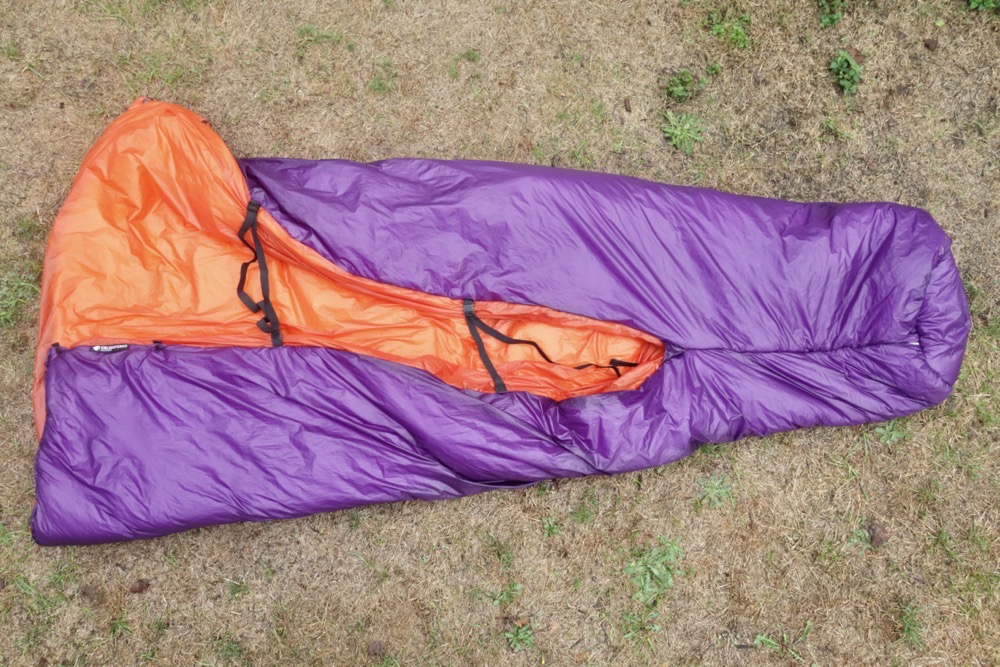
The Enigma APEX is a simple, no-frills quilt that pairs synthetic insulation with a classic design. By eliminating unnecessary features from ye olde sleeping bag, such as the hood, zipper, and back insulation, this quilt (and quilts in general) cuts weight to a minimum. For those going far or anyone who likes to carry less, a quilt is worth a look. The Enigma specifically is simple even by quilt standards. No opening the footbox with a zipper on this thing. It’s sewn shut for boosted warmth around the feet. If you suffer from chronically cold tootsies, the Enigma has you covered.
This version of the Enigma, using synthetic APEX insulation, is better suited than the down variety to handle damp and humid conditions. For this reason, going synthetic is worth considering for trips on the East Coast or notoriously wet trails such as New Zealand’s Te Araroa. It’s also vegan-friendly for those backpackers who choose to eschew animal products, not just in what they eat, but also in what they wear and carry.
Circumstances of Review
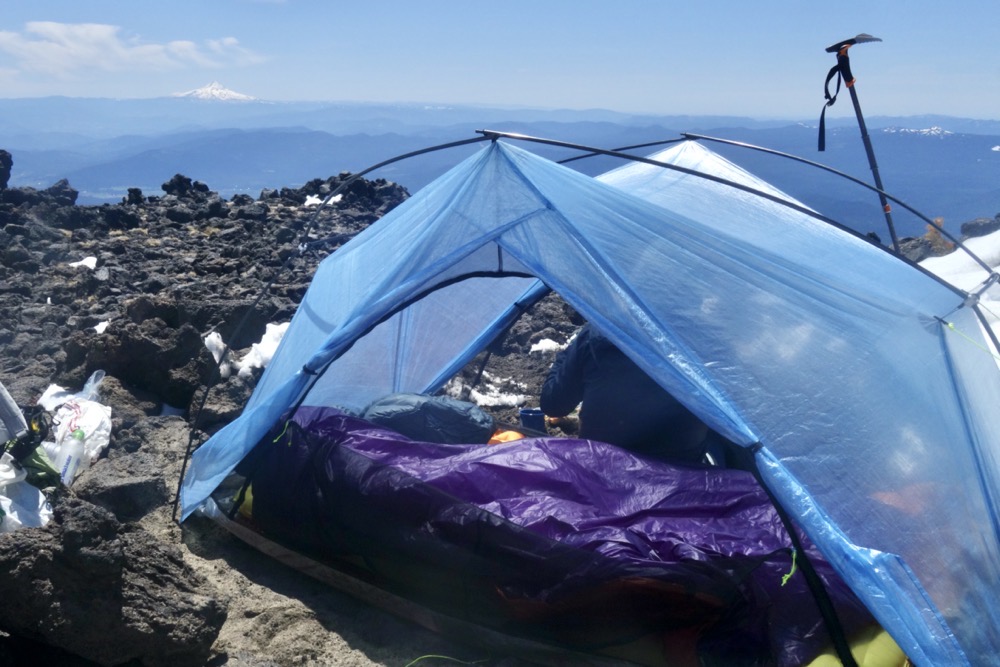
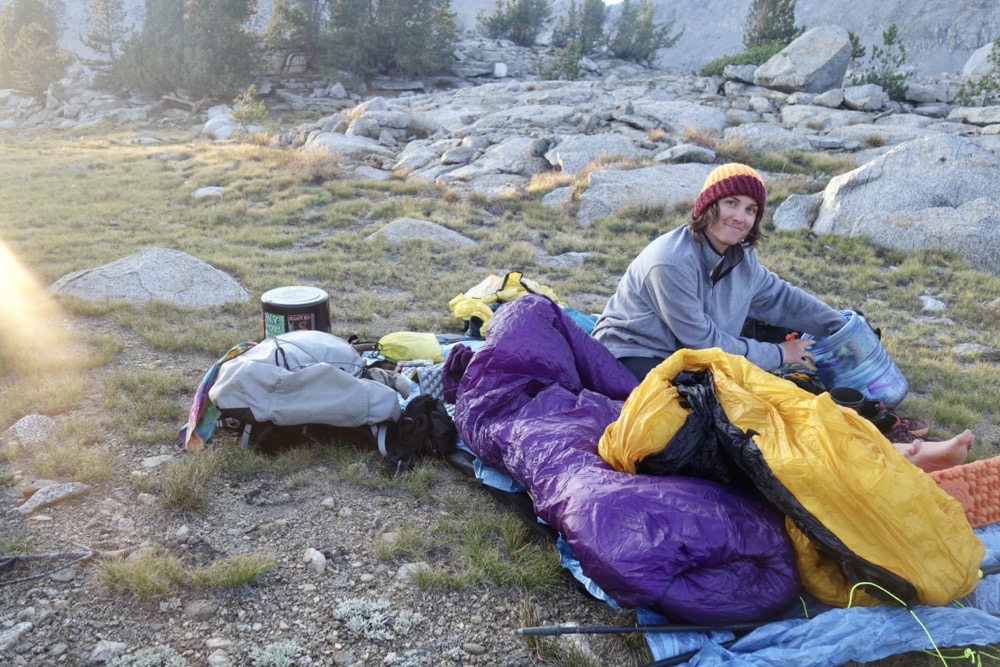
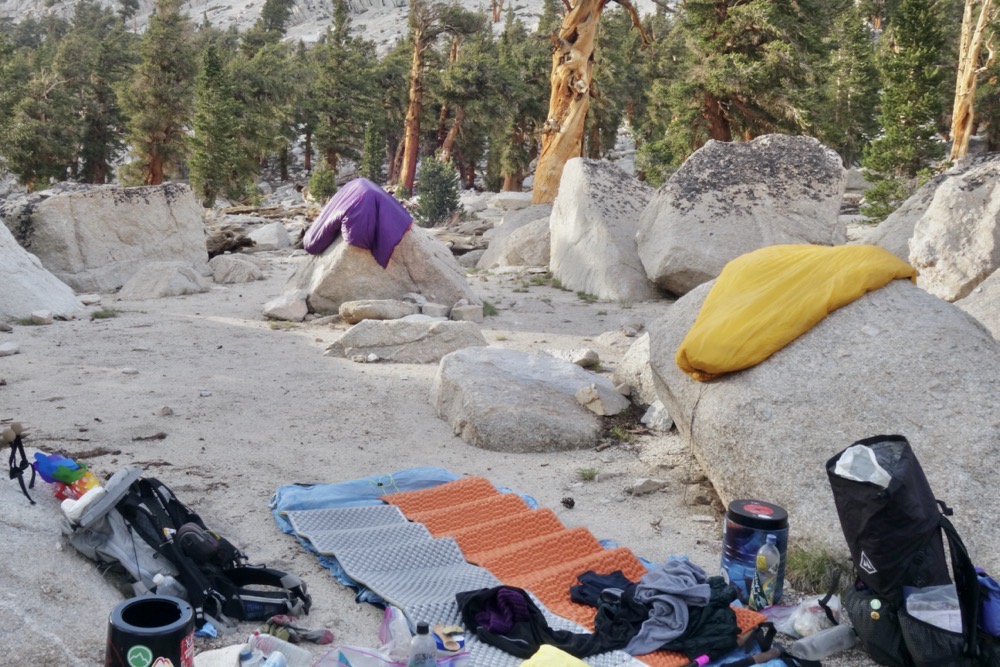
I picked up my Enigma APEX ahead of a 23-day sojourn on the Sierra High Route (SHR) and Southern Sierra High Route (SoSHR). With most of the route well above 10,000ft, I was expecting warm days and cold nights. However, a heatwave kept the days scorching and nighttime temperatures mild despite the altitude. Most of the time, my 20°F Enigma provided way more warmth than I needed, though there were a few nights that dipped below freezing. On these occasions, I was happy to tuck in tightly and snuggle deep. I would have preferred colder temps to stretch the comfort limit of this quilt, but still confirmed with great certainty that it is significantly warmer than my 30°F quilt.
Several consecutive stormy nights provided unwelcome opportunities to test the Enigma’s damp weather performance. Heavy condensation on the interior of my tent soggied up my footbox and mood, and it was a few days before I had the chance to let either fully dry.
Enlightened Equipment Enigma APEX Features

Customizable: EE has made a name for themselves by offering great gear that is ridiculously customizable. And it goes way beyond funky color combinations. Quilt length, width, temperature rating, and fabric weight are all subject to customer preference with the Enigma. If you have questions about sizing a quilt, EE has you covered with useful “Size Chart” and “Specs” tabs on the product page.
Sewn footbox: Some quilts have a zippered footbox that enables them to open flat. The Enigma does not have that. Instead, the footbox is permanently sewn shut and extends to about the knees. This configuration is warmer, lighter, and more durable (no zipper).
Snap and drawcord neck closure: Two button snaps behind the neck with an adjustable drawcord help regulate temperature and seal out drafts.
Synthetic insulation: 2oz/yd² Climashield™ APEX synthetic insulation retains warmth even when damp and is easy to clean.

Pad attachment system: As with all EE quilts, included with the Enigma are two elastic straps that help attach the quilt to any sleeping pad up to 25” wide. One strap loops around the sleeping pad and clips to the quilt, keeping it in place. The other secures the opening at the back of the quilt, tightening it around the sleeper. When the temperature drops, these straps make a huge difference by blocking drafts and reducing excess airspace.
Warm and Spacious
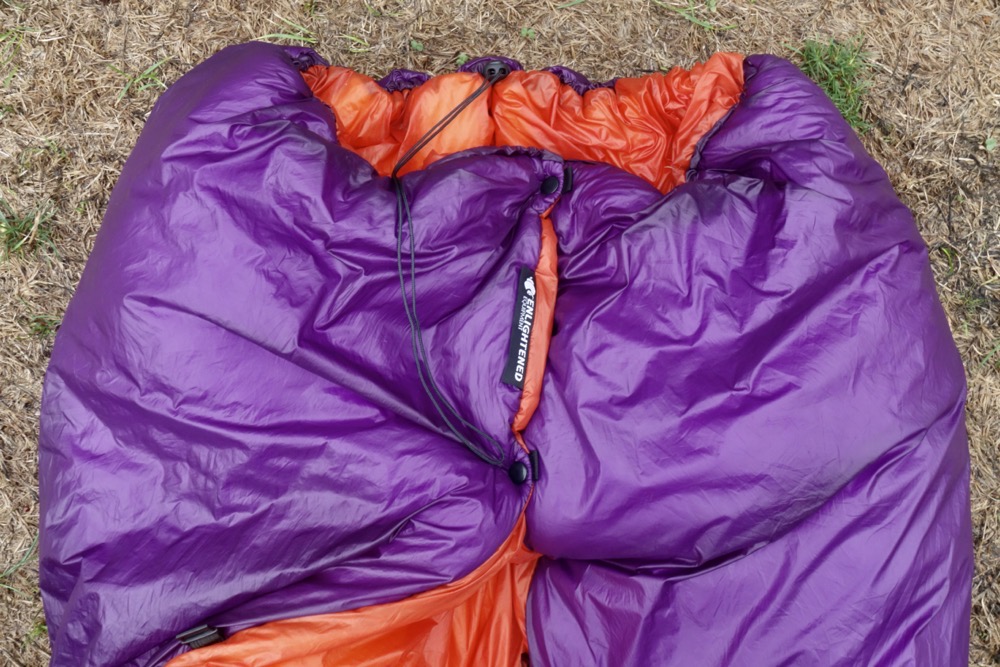
My experience with the Enigma APEX has been unremarkable in the best way. A quality night of sleep is hardly something to talk about after all, and the bulk of my nights with this quilt fall into this category. On the SHR, the lower limit of this quilt was never really tested, but I can confirm that this thing is a furnace. This was first apparent just by looking at the darn thing. It’s pleasingly poofy, and the APEX insulation feels thick. During 20 nights I did not once consider that I might be cold despite using a sleeping pad with a measly 2.0 R-value. Although the higher-than-average temperatures had a lot to do with that (duh), I was able to sleep comfortably in just my base layers even when the ground gathered frost. For reference, I usually wear my hooded puffy to bed to stay comfortable in my 30°F quilt. When I got too hot, which was often, it was easy for me to stick out a leg or release an arm or two.
That brings me to my next point, the Enigma is comfortable. I found it to be roomy when I wanted it to be on warm nights, yet sized perfectly to snug tight, eliminating cold spots, when I needed to warm up. When spec’ing out my Enigma, I struggled mightily to settle on a length and width. As a small person who tends to curl up when I sleep, I was tempted to go for a short/slim quilt to save a few ounces. Ultimately, EE’s sizing guidance steered me to a regular/regular, which was absolutely the right choice. This much customization choice in the hands of an ounce-counter is a dangerous thing. Fortunately, EE is savvy to these deleterious urges and provides the tools needed to produce a proper fit.
Closed Footbox For The Win

On one occasion, my partner, SpiceRack, and I switched quilts for the night. I was tired of sleeping hot, and she was tired of sleeping cold. Her 30°F Revelation, which has the ability to open completely into a blanket, utilizes a cinch cord to close the footbox on colder evenings. This is a cool feature, but I’ve always been skeptical about how well this protects the feet from the cold. Now I know. I immediately noticed a draft, could practically hear it whistling, through the tiny open hole at my toes. That night, my feet were significantly colder than they ever were with the Enigma.
This experience confirmed my suspicion that fully-closed footboxes are the way to go. Unless there is a specific, non-speculative reason for choosing a quilt that opens flat, a quilt like the Enigma does a better job providing what one needs — warmth — with a simpler and lighter design.
Packability

A significant downside to synthetic insulation is that it is bulky when compressed relative to down. EE’s APEX insulation is pretty good in this regard, but it is still something to consider if space in your pack is at a premium. I’m used to my down 30°F quilt packing smaller than a football. This 20°F Enigma APEX is roughly double that size in the included stuff sack. Officially, the 20°F down Enigma compresses to 7 liters, and the 20°F APEX Enigma squeezes to 12.5 liters.
To mitigate this issue, consider ditching the stuff sack. Instead, let the quilt or sleeping bag remain at large in the pack, filling in the awkward gaps between lumpy pieces of gear. I load my quilt first, stuffing it to the bottom of my pack, then jam oddly shaped items in next — tent, inflatable sleeping pad, electronics. The quilt squeezes between them like mortar between stones. Using this technique on the SHR, I was able to fit my Enigma APEX and a mighty haul of food in a relatively small 45-liter pack. This, of course, also works with down quilts and bags.
EE warmth rating
As EE explains in a super helpful article, their quilt temperature ratings are most consistent with the “limit temperature rating.” That means that they correspond to the temperature ratings typically given to men’s or unisex sleeping bags. Women’s sleeping bag ratings, on the other hand, typically represent the “comfort temperature,” which ranges 10-15°F warmer than the limit temperature. So what that means is that a 20°F men’s sleeping bag will not be as warm as a 20°F women’s sleeping bag.
Applying this to an EE quilt, hikers used to a men’s sleeping bag rating do not need to adjust their preferred temperature limit. Hikers who have dialed in their comfort based on the women’s sleeping bag temperature scale should consider buying a “warmer” rated quilt to keep that same level of warmth. Adding 10° is probably enough.
Synthetic vs. Down Insulation

The strengths and weaknesses of both down and synthetic insulation have been explained in a number of articles already. Broadly, down is lightweight and compressible, but it also approaches uselessness when wet and is expensive. Synthetic insulation is cheap and has good wet-weather performance, but is heavier and more bulky than down.
Despite the drawbacks, I chose to stuff my Enigma with APEX synthetic insulation rather than down. With big plans on the East Coast next year, I want a quilt that can handle the wet and humid conditions of Appalachia. Yet, however practical that reason may be, it is secondary to the rarely discussed consideration of ethics and animal welfare. As I transition all aspects of my life toward a vegan lifestyle, that commitment has spread beyond the kitchen and all the way to my gear closet. It is hard to ditch down for this wannabe ultralighter, but in this case, the extra ounces and bulk are worth it to me. In my view, it’s the only choice that I can ethically justify*.
I’m not here to push my vegan agenda, but even down produced in agreement with the Responsible Down Standard (RDS) is exploitative. Sure, it doesn’t allow for live-plucking, force feeding, or other cruel practices, but it still permits the commoditization of living beings in a way that eliminates their consent and values their lives as less than our own. I’m not saying that geese need governmental representation, only that, as humans, our technological advances allow us to now choose compassion over exploitation.
*Caveat: Above all, purchasing gear/clothes/whatever used is the best way to reduce the negative impacts of your consumption. A used down sleeping bag is in many ways better for the planet than a new synthetic version.
Enlightened Equipment Enigma APEX Pros
Price: Not only is synthetic insulation cheaper than down, but it also takes less labor/skill to craft into a useful piece of gear (down requires fancy baffling to keep feathers in place). This means that a synthetic quilt is significantly cheaper than the down quilt equivalent with the same temperature rating. For example, my same quilt made with 850-fill down costs $315. With über-quality 950-fill down, the price jumps to $385. Direct comparisons aside, paying $230 for a sub-two-pound custom quilt is a steal. Synthetic wins for those on a budget.
Warm: As I said above, my 20°F Enigma is roasty. EE doesn’t skimp on the insulation. I didn’t need it on the SHR, but I’m ready for whatever the shoulder seasons throw at me.
Weight: Synthetic insulation still has a ways to go before it can equal the warmth-to-weight ratio of down, but the gap is small. With the Enigma, choosing APEX insulation adds about 7 ounces to the total weight, which I think is a pretty small number and worth it. And relative to other sleeping bag options, the APEX Enigma is still crazy light. Outside of the cottage gear industry, it is tough to find a 20°F bag that even approaches 2 pounds, down or synthetic.
Customizable: EE is known for their ultra-customizable gear, and the Enigma is no exception. One can choose insulation type, temperature rating, length, and width, not to mention the 19 outer fabric and 15 inner fabric options. All that customization can feel overwhelming, but EE’s website is replete with the information you need to find the right specs for your needs. Balance weight, warmth, and style just the way you like it.
Cruelty-free: I’ve pushed this enough already. By replacing down with synthetic insulation, we avoid arbitrarily defining “responsible” and eliminate an avenue towards animal exploitation.
Made in USA: Each Enigma quilt is handmade in Winona, Minnesota. I’ve never been to Minnesota, but I hear that it’s a great place to make quilts.
Enlightened Equipment Enigma APEX Cons

Bulk: This might be the biggest drawback to synthetic insulation — it does not compress as small as down. My stuffed Enigma is absolutely huge compared to my down quilt. However, this is really only an issue if you’re using a minimalist pack. It is something to consider, though. For reference, on the SHR, I still managed to fit a bear canister and 8 days of food in a 45-liter pack despite the extra bulk of the APEX insulation. Tip: Ditch the stuff sack for more efficient packing.
Weight: Can I put this in both the pros and cons? Meh, why not? The APEX Enigma is light, but the down versions are lighter. For the time being, down insulation cannot be beat when weight matters most.
Loose fabric: APEX insulation comes as a continuous sheet, which means that EE does not stitch any baffles to keep it in place. The result is three layers (inner, insulation, and outer) that are not bonded anywhere other than at the edges. This gives my Enigma a baggy, loose feel. The effect doesn’t bother me most of the time, but my feet sometimes struggle to find the footbox in all the loose material. Especially when they are sweaty, which is all the time.
Quilt sacrifices: Inherent to the quilt sub-genre of sleeping bags, there are drawbacks, hence the reason that the majority of backpackers use full sleeping bags. Most importantly, quilts can be drafty even if used properly, and they don’t have hoods to keep your dome warm. The effects of these are easily mitigated with experience and proper layering, but the Enigma is not immune to these deficiencies.
Lead time: Custom gear from EE can take weeks to ship. Understandable, but that doesn’t work if there’s a time crunch. The current lead time for an APEX Enigma is 3-5 weeks, but that can increase during peak season. Plan ahead, and order early.
Final Thoughts
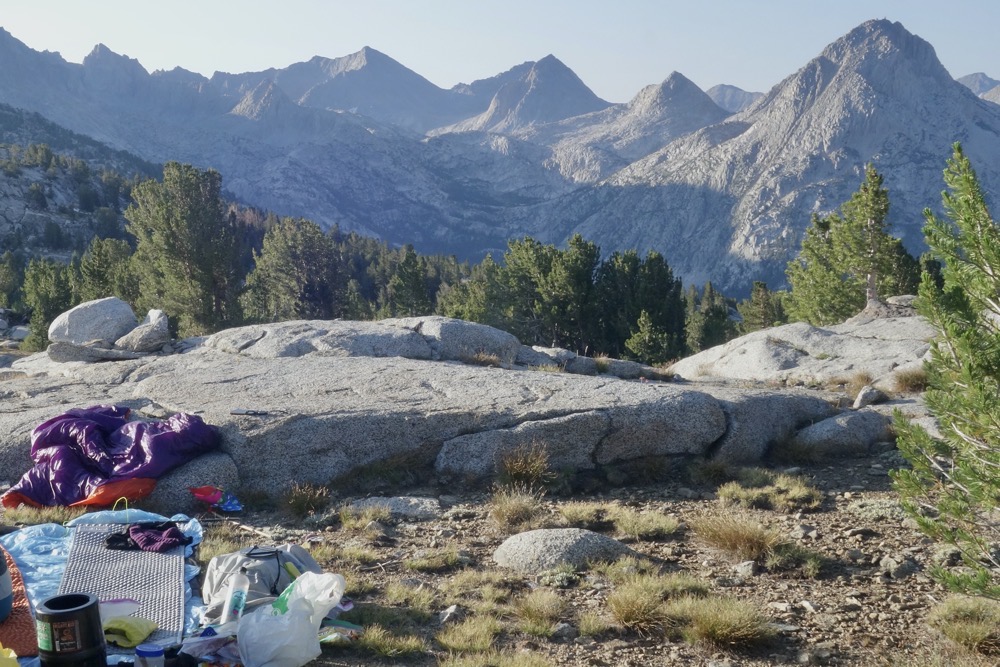
The 20°F Enigma APEX was too much quilt for a warm trip on the SHR. The 30°F version would have been more appropriate for the high summer heat. However, despite being too warm on most nights, I was impressed by the simplicity and comfort that the Enigma brought to bed each night. I loved that I could stretch out when I wanted to and that my feet always had a warm place free from drafts. On wet days, as condensation dripped down the inside of my tent, I rested easy, knowing that I would still be warm despite the dampness.
The extra weight and bulk is what it is. For now, down is still the better insulator in dry conditions, but for me, the extra ounces are worth it. And even though the Enigma APEX is heavier relative to the down Enigma, it is still a remarkably lightweight quilt. The warmth-to-weight ratio is up there with all but the lightest offerings by the cottage gear industry.
The Enigma APEX is also a great value with a performance-to-cost ratio that is hard to beat. If budget is a major factor, going synthetic can save hundreds of dollars.
Ultimately, my Enigma APEX feels like the perfect quilt to fit my needs when I encounter the inevitable cold, damp days of early spring on the East Coast. The APEX insulation will keep me cozy, and the custom colors will keep me smiling. EE does a lot of things right, and offering this great Enigma quilt design in a synthetic version is one of their better moves so far.
Similar Ultralight Synthetic Quilts
If you are aware of any other synthetic quilts, I’m always looking for more… Let me know.
Mountain Laurel Designs Spirit Quilt
MSRP: $215-$245
Temp rating: 28°, 38°, 48°F
Weight: 19-26 ounces
Insulation: ClimaShield APEX
Read my review of the MLD Spirit here.
Enlightened Equipment Revelation APEX
MSRP: $175-$240
Temp rating: 20°, 30°, 40°, 50°F
Weight: 12-30 ounces
Insulation: Climashield APEX
Affiliate Disclosure: In my ongoing quest to avoid living comfortably and working in an office, I have incorporated affiliate links on this website where appropriate. If you make a purchase through these links, I might earn a few bucks at no additional cost to you. That's pretty cool, huh? You'll be like a modern-day Robin Hood, taking money from "The Man" and giving it to this hungry dirtbag. Burritos for all!
 Hike For Days