
This review was originally published on TheTrek.co, and this tent was donated for the purpose of review. If you have any quick questions for me about gear, please feel free to contact me. And if you want to dive deeper, or talk about other aspects of backpacking, I offer Thru-Hike Coaching. I’d love to contribute to your journey!
UPDATE: The Free Duo has been discontinued and replaced by the Free Zip. Check out my review of the Free Zip 3P here.
The Free Duo Tent is an exciting addition to the well-regarded line of ultralight Dyneema Composite Fabric (DCF) shelters from Zpacks. With this tent, the company goes where none in the cottage industry have dared to dabble: into the realm of freestanding shelters. Traditionally, this has been the purview of big brand manufacturers, producing a plethoric quagmire of brightly dyed silnylon. Dual-walls, aluminum poles, long zippers, and footprints, representing the latest innovations of the old guard, define most shelter offerings found at major outdoor stores such as REI. While DCF is beginning to creep into the mainstream market, it has, for the most part, remained absent from the showroom floor.
Meanwhile, the cottage industry has grown up with DCF, which is now inexorably linked with the dirt-clad hikertrash of thru-hikingdom who use trekking poles and tediously placed guy lines in tandem to hold up this most sacred of fabrics. So far, major drawbacks in price and ease of use have kept DCF trekking pole shelters off the gear lists of all but the most weight-obsessed backpackers, but with the Free Duo, Zpacks has taken one more step in the meshing of old and new, traditional and ultralight.
The Free Duo combines over a decade of cottage industry DCF know-how with the practicality of a traditional freestanding shelter. The result is a tent that promises to be supremely user-friendly while maintaining the benefits (and premium price) of DCF. I’ve had my frustrations with both trekking pole shelters and old-school tents, and the idea of the Free Duo gets me more excited than I care to admit. Let’s see if Zpacks gets close to the “this one’s just right” middle ground, or if this hybrid struggles to find its place in a crowded gear market.
My own story
I’ve used a lot of tents during my tenure in the outdoors, from my parents’ musty green, spider-filled dome tent to my first decent backpacking tent, a two-person somethingorother that I was gifted 15 years ago. I even spent a summer living in a teepee while teaching blacksmithing at a Boy Scout camp in the Sierra. These tents all treated me well and enabled me to endure some ferocious nights in beautiful places.
When I put together my gear list for the PCT in 2015, I fell into the world of ultralight shelters, the likes of which I couldn’t have imagined. Hello cuben fiber. Sayonara, separate fly sheet. Adiós, aluminum poles. Going all in, I gave up tents altogether and convinced myself that I needed the most ludicrously expensive tarp I could find. It packed to the size of a large burrito and weighed about a pound, which was great, but setting it up was a huge chore. On many nights, I risked getting soaked while cowboy camping, rather than take the irksome effort required for a solid pitch. “A tarp is wonderful when one can cowboy camp 90% of the time,” I decided after five straight days of rain in Washington. I love my tarp and have used it successfully against rain, wind, and snow in the US and while dirtbagging in the Alps. However, even after using it for years, I wished for an easier pitch and more walls.
My tarp spent most of the CDT tightly furled in my backpack, as I moved into my partner’s Duplex on nights unfit for cowboying. The full-sided protection from rain and bugs was essential on that trail, and the Duplex did an amazing job for us while only weighing a few ounces more than the tarp. And though the Duplex is a straightforward pitch and much easier to set up than a tarp (especially with a friend), the large footprint and required bomb-proof stake placements limited campsite selection. On windy nights, our laziness was punished with incessant flapping from our floppy tent.
As I focus my sights back to the alpine environment that makes up the majority of the terrain along many coveted high routes, I feel that I’ve come full circle. The freestanding tents of my youth look better every day as I consider the rocky ground above the Sierra treeline. Since leaving them behind in 2015, shelter technology and designs have improved significantly, shrinking the weight gap between non- and freestanding shelters. Sub-two-pound tents are easy to find, while pounding stakes into rocky dirt is as lame as ever. And with Zpacks finally bringing to market a freestanding, single-wall, DCF shelter, I think now is a great time to reevaluate my relationship with tent poles.
The Free Duo carries a significant weight penalty over similarly sized trekking pole shelters (11 ounces over the Duplex). It is impossible to quantify the benefits of a freestanding shelter design so simply, which shift from hiker to hiker based on individual preferences. Ultimately, my question is this: how well does the Free Duo combine the best properties of traditional and ultralight shelters? Is it an overweight ultralight shelter, an overpriced rehash of an old design, or does it combine the best of both worlds?

Zpacks Free Duo At-a-Glance
MSRP: $699
Shelter Type: Freestanding, single wall, two ‘H’ poles
Stakes Required?: No, but you probably want at least two
Materials: DCF tent, carbon fiber poles
Weight* (my measurement): 30.15 ounces (17.05oz tent, 13.1oz poles)
Packed Size: 7” x 13” tent, 2.5” x 20” poles
Capacity: Two people + gear
Number of Doors: Two
Vestibule Area: 4.8 square feet each
Floor Size: 42” wide, 90” long
Peak Height: 42”
Bug Protection: You betchya
Country of Origin: USA
*not including stakes: Ultralight titanium stakes from Zpacks (0.2 ounces, $2.50 each)

Intended Use
For years, Zpacks has offered some of the most capable and popular ultralight shelters. They are lightweight, durable, and functional. Their olive drab DCF is a more common sight than most wildlife on the long trails of America. The two-person Duplex Tent is a perennial contender for the title of most popular shelter for thru-hikers, regardless of the trail, and has been the gold standard of trekking pole shelters for years. It’s hard to argue with a 19-ounce two-person tent, but it’s not perfect and shares the same limitations that hinder almost all trekking pole shelters. They can be finicky to pitch, with a steep learning curve, and require a discerning eye for choosing a suitable campsite. With creativity and skill, one can overcome these challenges, but if you’ve ever tried to pitch a Duplex on a slab of granite while wondering “there must be a better way,” I’m with you. The better way is here. It always was.
The answer is a freestanding tent, like the ones that have been around for a long time. The Free Duo is designed to be a home to those hikers who like to explore places that reject highly tensioned tent stakes, such as granite, slick rock, sand, snow, packed dirt, concrete, or pavement. For the weight penalty of the added pole structure, hikers who opt for the Free Duo over a trekking pole shelter will benefit from the increased versatility of a tent that can handle high winds and pitch virtually anywhere. It’s also a great choice for anyone who prefers not to hike with trekking poles at all.
Zpacks Free Duo Features

DCF: The Free Duo is constructed using a combination of DCF and bug mesh. The canopy is .55oz/sqryd DCF while the floor is 1.0oz/sqryd DCF, which is rugged enough to survive a thru-hike without an additional footprint. DCF is an excellent material for tents because it is fully waterproof and does not absorb water, so it dries quickly and does not sag.
Freestanding: More on the features of a freestanding tent later, but the Free Duo differs from all other Zpacks shelters in that it employs specific tent poles for structure rather than trekking poles. That means that it stands without stakes, although two are required for the vestibules. This is what makes this tent special. It goes places trekking pole shelters can’t.
‘H’ shaped poles: The pole structure of the Free Duo is unique. Instead of poles that span the entire length of the tent, two separate ‘H’ sections attach at the floor corners and tent peak. Clips attach the canopy to the two horizontal sections. Similar to other pole designs, they are a bit unwieldy to handle solo, and they’re not revolutionary or disastrous. With minimal attachment points, they keep the tent amazingly taught.

Two rainbow doors: Big zippers in the bug mesh allow for each wall to open entirely for easy entry/exit, no matter which way you’re facing. This is the same design found on the Duplex, but the Free Duo misses the trekking poles blocking the center of each door for a much more spacious feeling.
Vestibules: Two vestibules provide plenty of protection for shoes and gear for two people. These are classic Zpacks vestibules taken straight from the Duplex. Each has two storm flaps that open individually or at the same time for ventilation in good weather. Even with these flaps completely stowed, a slight overhang in the canopy keeps drips from splooshing inside in the calmest precipitation.
DCF Advantages and Disadvantages:
For anyone looking to lighten their Big 3, the gravitational temptation of DCF is cosmic. The material seems like something used in space (though it has origins in sailing), and has a lot to offer the backpacking community over traditional nylon variants. Check out this tent review for an in-depth explanation of the benefits and drawbacks of DCF. Rehashing the main points here, the advantages of DCF are the exceptional strength-to-weight ratio, 100% waterproofness, and ease of repair. That means a lighter, super-strong tent that won’t sag with extra water weight when wet, and is easily repaired in the field.
On the flip side, the main drawbacks of DCF are packability and price. While a packed DCF shelter is only slightly bulkier than a similar SilNylon version, the price difference can run in the hundreds of dollars. Gear budgets are highly variable, and the premium price of DCF will stretch many too thin.
Look Ma, No Stakes: Freestanding vs. non-freestanding
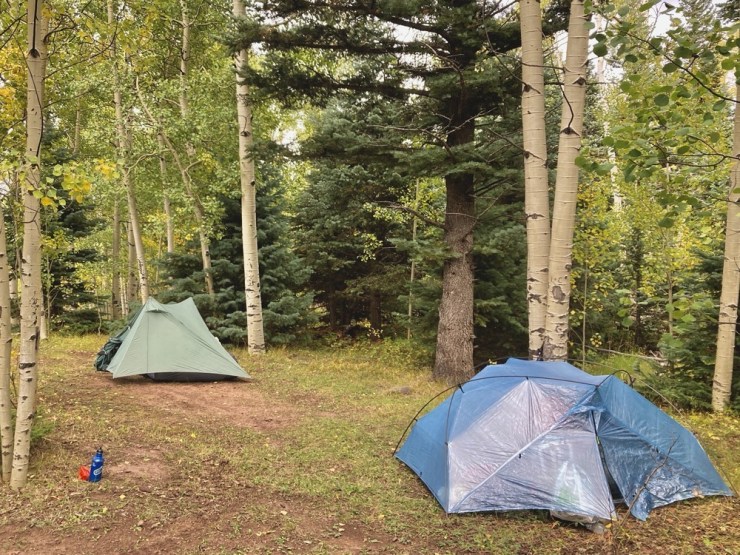
Freestanding tents were the norm for years and arguably still are if one looks beyond the thru-hiking community. The domes of old have been updated with more complex and efficient designs enabled by better materials, and the benefits of this style persist, enhanced by modernity. Here are some ways freestanding tents outperform similar non-freestanding options:
Easier setup: Freestanding tents set up the same way, every time. There’s very little adapting, if any, to match the terrain of a camp spot, and the procedure is similarly consistent. Poles, clips, then one or two stakes, that’s it. Trekking pole shelters often require a delicate balancing act to keep the first/only pole upright while the stakes are properly arranged and tensioned. Wind and rocky ground will frustrate just about anyone, and guy lines usually demand multiple adjustments. Anecdotally, I circle the Duplex three or four times, tweaking the line tension and stakes before diving in for the night. Maybe I’m just terrible at using tents, but one circle is good enough for the Free Duo.
No stakes required: A freestanding shelter will stand without stakes or guy lines, which makes this style particularly well-suited to adventures in places with stake-unfriendly ground. A standard two-person freestanding tent, including the Free Duo, will accept up to eight stakes; four at the corners, one at the head and foot, and one to hold out each vestibule. In reality, only the windiest conditions warrant using all eight. More common is using just the two needed for the vestibules, though on fair nights, even these can be ignored when totally furling the storm doors.
Smaller footprint: Because it stands without stakes and the attaching guy lines, the Free Duo requires less space to pitch than the Duplex. The living space of each is roughly the same (slight edge to the Duplex), yet the latter is much harder to nestle into tight places. For comparison, when I pitched the two side-by-side, the four corners of the Free Duo made a rectangle with dimensions 86” x 40”, while the Duplex dimensions were 100” x 59” (varies with stake placement).
Less finicky: A novice will pitch a freestanding tent about as well as a skilled user. They might take more time, but the final product will be darn near identical and functional. Pitching a trekking pole shelter, however, promises a lifetime of learning opportunities. The guy lines, stake placement, and trekking pole(s) are all adjustable. Balancing these is as complex as forming a perfect sphere out of sticky cookie dough, and rough weather loves to punish the impatient. It takes practice and luckskill asdfkljsadf;klasjd to near perfection, which will be different every time.
Wind performance: In general, more poles mean more structure, and they help distribute the wind loads to the canopy more evenly. The carbon fiber poles of the Free Duo provide structure that outclasses that of most trekking pole shelters, especially when stake placement is questionable. The poles also guarantee a taught canopy, which is less prone to damage and much quieter than a flappy canopy.
Free trekking poles: This might not be a huge selling point for thru-hikers, but having hikeable trekking poles AND a shelter is important in adventures utilizing a basecamp. Want to bag Mount Whitney from the PCT while leaving your gear sheltered at Crabtree Meadow? The Free Duo lets you do that.
The “Free” in Freestanding Ain’t Free
Legitimate downsides to freestanding shelters are few, though major. The big one is weight. Double-wall tents obviously suffer from added ounces of excess fabric, but even the lightest single-wall shelters, including the Free Duo, come with a weight penalty over equivalent trekking pole options. The poles provide a robust structure and spacious interior, but even the lightest sets weigh close to a pound and serve only one purpose. Trekking poles, on the other hand, earn their weight while hiking and in camp.
The poles are also bulky. Virtually any backpack will carry them easily using the combination of a side pocket and compression straps, but that configuration steals easy-access real estate from more useful items like water and snacks.
Middle Ground: Freestanding vs. semi-freestanding
There is some middle ground between a freestanding tent like the Free Duo and a trekking pole shelter like the Duplex. I’m talking about semi-freestanding shelters. Like a fully freestanding tent, these utilize poles for structure and so share many of the benefits of that lifestyle. The ‘semi-‘ qualifier is earned because some stakes are required to give full shape to the floor, usually two at the foot-end corners. These tents are some of the lightest available, even though many boast double walls.
The Free Duo has a definite weight advantage versus the best semi-freestanding tents. It also has an edge in the number of stakes required, although some clever hikers have used a trekking pole to convert semi-freestanding to freestanding. However, affordability is where the Free Duo stumbles in this comparison. Semi-freestanding tents from big-name brands, while still expensive, cost hundreds less. You miss out on the DCF, but these cheaper options still make a great home during months of hiking. However, any tent is cheaper than rent.
Ease of Use
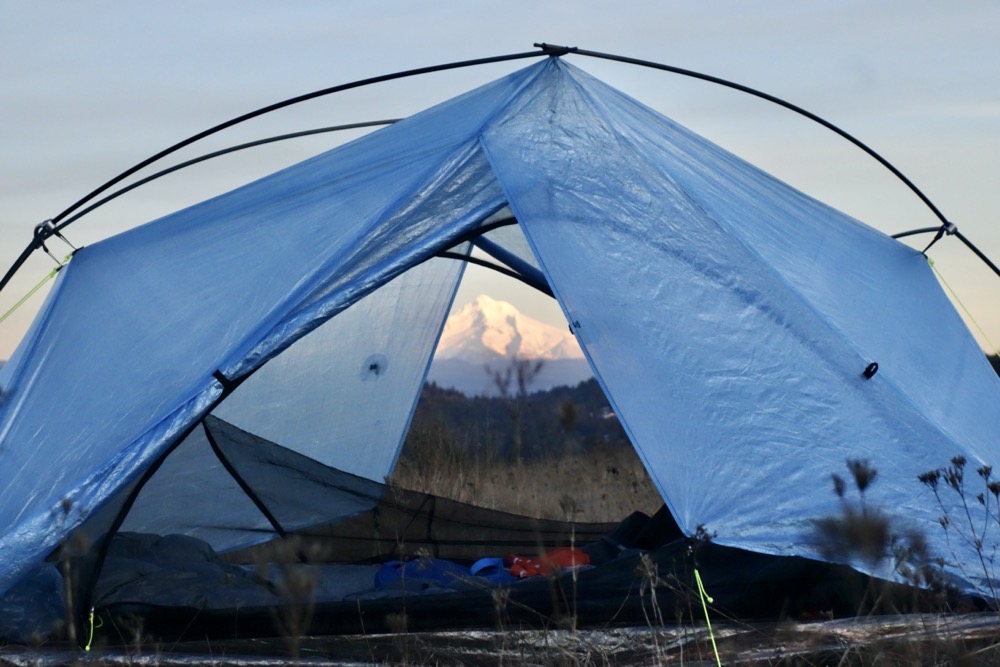
The Free Duo is the most user-friendly tent I’ve used. The freestanding benefits are well represented, which make it quick and easy to set up just about anywhere, including in the basement to dry after a wet night. The single-wall construction also shines. Setting and packing it up are easier than a traditional two-wall tent because there is no added labor needed to manage a fly sheet. Ditto for a footprint. In this regard, the Free Duo adopts some of the best features of the ultralight trekking pole shelters, which go a long way to making it simple to use.
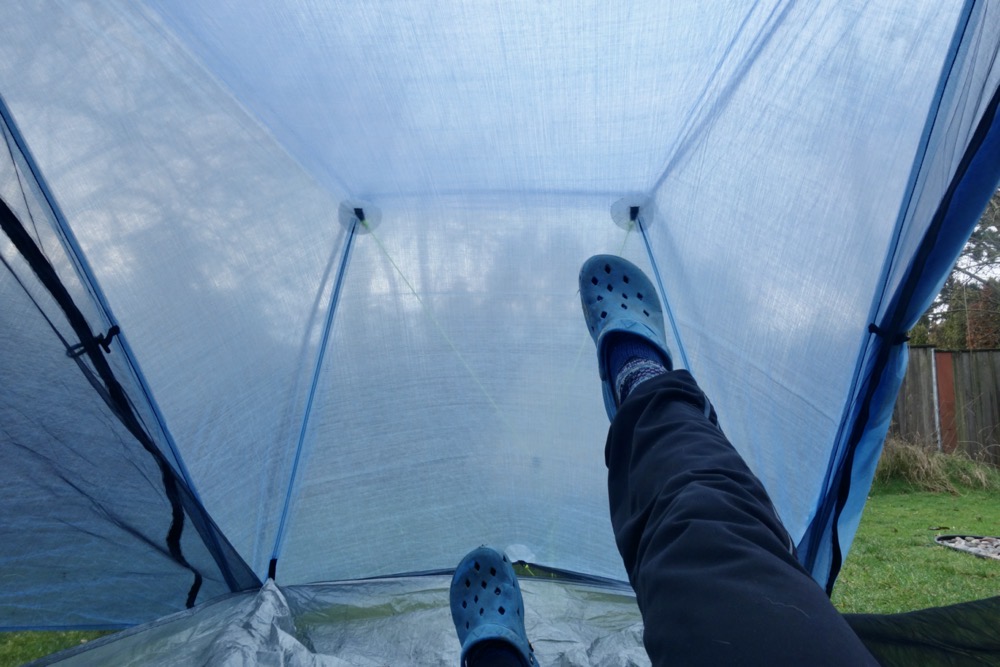
In addition to that simplicity, the structure of the Free Duo folds in the benefits of traditional tents. Despite having a peak height 6 inches less than the Duplex, it feels roomier with more functional space above the head and feet when prone. The poles pull the canopy outward so that it creates a more concave interior than the Duplex, which is essentially an A-frame. This difference is noticed as more shoulder room when sitting up, and much more airspace above the face and feet when lying down, which reduces contact with condensation on the inside walls.
Other sweet features of the Free Duo are carried over directly from the Duplex. The dual doors are great for partners, and the vestibules provide plenty of space to store gear and shoes.
Zpacks Free Duo Pros
Freestanding: The Free Duo can be pitched on virtually any surface with a minimal stake requirement. That means reliable weather protection in more awesome places. It also makes drying it out in your basement a breeze.
Quick setup: Pitching the Free Duo is dead easy. No need to guess at stake placement or adjust trekking poles. Just snap together the two poles and insert the tips into metal rings at the floor corners and center peak. Two clips attach to each pole at the ‘H’ crosspiece, making the canopy tight like a drum. Add one stake for each vestibule and, voilà, all done. On my first try, this took five minutes. Importantly, it will be this easy almost anywhere and on any surface.
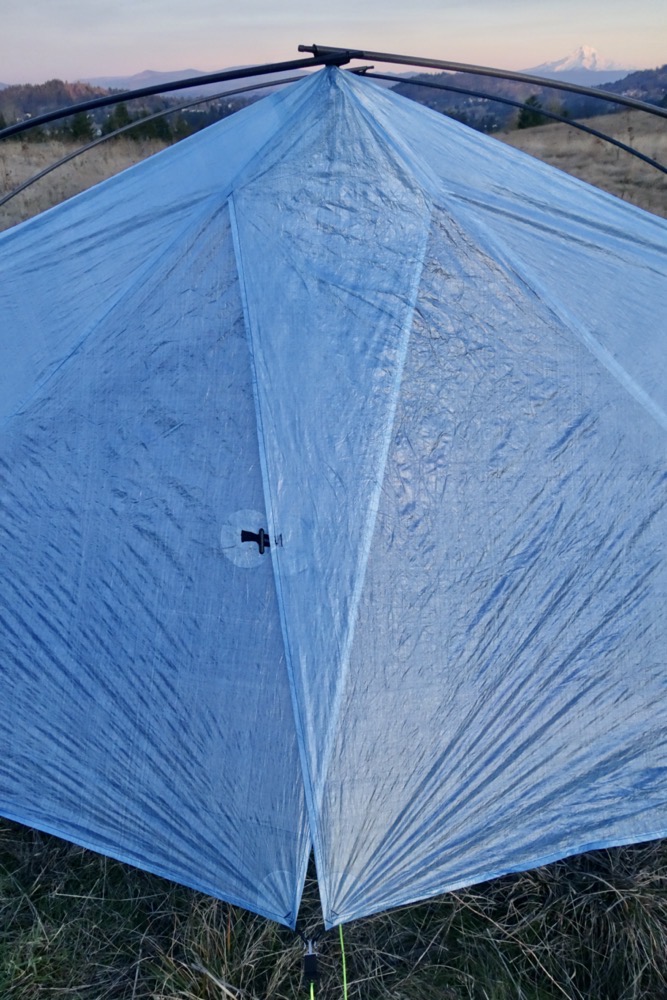
DCF: This fancy fabric is strong, lightweight, waterproof, and relatively durable. It’s an excellent fabric for tents, and Zpacks makes full use of it with the Free Duo. The thin DCF canopy keeps weight down while the thicker bathtub floor provides durable protection without the need for a separate groundsheet.
Can divide weight: This two-person tent is easy to divide between two people. One can take the poles, the other carries the tent body. Share the load.
Lightweight: DCF, carbon poles, and single-walled construction make the Free Duo the lightest two-person freestanding tent available. It’s not as light as many non-freestanding shelters, but the dedicated poles provide some very real benefits for the weight penalty. Some semi-freestanding tents also claim a lower weight on the stat sheet, but I’m skeptical of their durability. To mitigate this, footprints are recommended, which add around 6 ounces to the total, eclipsing the 30-ounce Free Duo.

Long-lasting: The Free Duo is built to last. While my tent has yet to stand the tests of time, my partner’s Duplex, which is built using the same DCF materials, made it through the entire PCT and CDT without major issue. Even when cowboy camping, the flattened tent served as the groundsheet. Puncture resistance is a weakness of DCF, but the 1.0oz/sqryd floor is burly, and small holes were easily repaired with DCF tape.
Groundsheet not required: Continuing the last point, it’s sweet that, per Zpacks, “a separate groundsheet is NOT required for this shelter.” Just one less awkward sheet of fabric to mess with.

Moveable: Pitch the tent, then pick it up and move it where you want it. Is there a root in your back when you lie down? Not a problem, just move. This is also helpful for getting the most comfortable orientation on an angled slope. This is difficult to dial in with a trekking pole shelter.
Small footprint: The Free Duo requires less space to pitch than the Duplex or similar trekking pole shelters, where the required guy lines and stakes extend the footprint significantly in each direction.
Concave interior: The canopy of the Free Duo clips to the poles, which creates a concave, dome-like interior. This adds a ton of livable space versus trekking pole shelters, which usually feature straight lines from peak to foot. The Free Duo has way more airspace above the head and feet when compared to the Duplex, despite slightly smaller floor and peak height dimensions.
Unobstructed doors: The poles of trekking pole shelters like to hang out in doorways. They’re easy to work around, but often get in the way. By subtracting the trekking poles from the Free Duo, Zpacks subtracts door obstructions, letting us live free with views unhindered.
Zpacks Free Duo Cons

Price: $699. Ouch. That’s a big number, no matter how you look at it. However, it’s a fair price relative to the market. DCF is an expensive material to source and work with, and so will demand a premium price for the foreseeable future. Of course, the Free Duo also includes carbon poles, which justifies the higher price relative to the Duplex.
Stakes not included: For that price, I think stakes should be included. Sure, hikers might already own stakes or prefer a specific type, but I would hate to shell out another $20 for a set on top of $700. I also think that stakes are an important factor for an apples-to-apples weight comparison between tents. For reference, I carry eight 6” titanium shepherd hooks ($16, 1.4oz total) for my staking needs.
Bulky poles: Besides being useless for anything but setting up the tent, the Free Duo poles are rather bulky. The aluminum hubs at the connecting joints of each ‘H’ hold the carbon sections awkwardly far apart, meaning that they do not nest tightly together. Carry them on the outside of your pack to minimize the impact.
No trekking pole setup: With the Free Duo, you’re stuck with the poles, and if one breaks, you’re screwed. Trekking pole shelters are more flexible and can be used with either trekking poles or other appropriately-lengthed straight things, even sticks, if the inspiration strikes. For even awesomer flexibility, the Duplex Freestanding Flex Kit turns a regular Duplex into a freestanding shelter.
Condensation: Collecting interior condensation is a classic issue for just about any shelter. This affects occupants of single-wall tents more acutely because it’s nearly impossible to avoid brushing against the damp interior. When the weather permits, sleeping with the vestibule doors open will minimize condensation collection. Campsite selection can make a big difference, too. Here are Zpacks’ tips for reducing condensation.
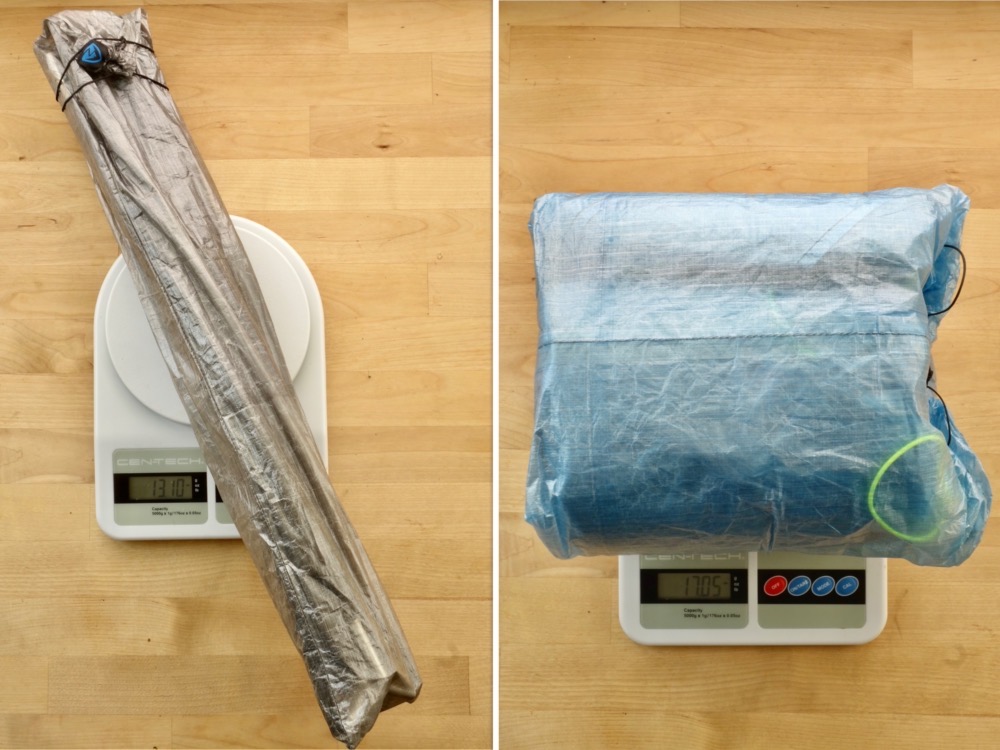
Heavy: While the Free Duo gets kudos for being a super lightweight freestanding tent, it is undeniably heavy from an ultralight perspective. The poles balloon the weight to 11 ounces heavier than the Duplex. However, the Free Duo is a fundamentally different tent, so much so that it almost feels ridiculous to compare the two weights. Yet I foresee that 11-ounce gap immediately disqualifying it from the wish list of many aspiring thru-hiker. Ounces are ounces. The benefits of the Free Duo are harder to quantify.
Final Thoughts

Zpacks accomplishes what they set out to achieve when creating the Free Duo. It is a shelter hybrid that combines the strengths of both freestanding and trekking pole tents. With a robust pole structure, it can pitch anywhere, and the single-wall DCF construction simplifies setup by eliminating entire layers of fabric and lightens what’s left by replacing it with super-strong Dyneema. The result is the lightest two-person freestanding shelter on the market. Other semi- or freestanding shelters come close in weight, but they lack the simplicity and the benefits of DCF. Trekking pole shelters beat the Free Duo on the scale, but they are more difficult to use.
Despite the clear Duplex heritage, ultimately, I feel the Free Duo is an upgraded freestanding tent, and exists in a separate galaxy from trekking pole shelters. The 11-ounce weight gap is significant. For someone in the market for a freestanding tent, the Free Duo represents a wholesale improvement. For ultralighters looking at the lightest trekking pole shelters, the additional weight of dedicated poles might not be worth the easy setup. And for anyone, the price might keep the Free Duo out of reach.

For me, the Free Duo is attractive because it enables me to go where I want to go and sleep where I want to sleep. Above the treeline on slick granite, my tarp doesn’t cut it. Some terrain demands a freestanding tent, and the Free Duo is not only the lightest option, but it also integrates some of my favorite features from the Duplex; the single-wall simplicity and benefits of DCF. It might not totally replace my tarp, but with wind or rain in the forecast, I’ll gladly lug the poles in exchange for the peace of mind that comes with a peaceful night’s sleep.
Similar Freestanding Shelters
Hyperlite Mountain Gear Crosspeak 2
MSRP: $950
Weight: 34 ounces
Material: DCF
Type: Freestanding, single-wall
Big Agnes Copper Spur UL2
MSRP: $550
Weight: 42 ounces
Material: Nylon
Type: Freestanding, double-wall
Durston X-Dome 2
MSRP: $500
Weight: 44 ounces
Material: Polyester
Type: Freestanding, double-wall
Tarptent Arcdome 2 Ultra
MSRP: $629
Weight: 53 ounces
Material: UltraTNT
Type: Freestanding, single-wall, 4-season
Tarptent Double Rainbow Li
MSRP: $799-$879
Weight: 27 ounces
Material: DCF
Type: Freestanding (with additional trekking poles), single-wall
NEMO Hornet Elite OSMO 2P
MSRP: $660
Weight: 27 ounces
Material: OSMO polyester-ripstop nylon
Type: Semi-freestanding, double-wall
Zpacks Duplex plus Freestanding Flex Kit
MSRP: $699 + $149
Weight: 19 ounces + 10.2 ounces
Material: DCF
Type: Trekking pole turned freestanding
Affiliate Disclosure: In my ongoing quest to avoid living comfortably and working in an office, I have incorporated affiliate links on this website where appropriate. If you make a purchase through these links, I might earn a few bucks at no additional cost to you. That's pretty cool, huh? You'll be like a modern-day Robin Hood, taking money from "The Man" and giving it to this hungry dirtbag. Burritos for all!
 Hike For Days